Identifying Special Cause Variation Can Be Done Using Which Tool
Recording customer contact information. Interpreting charts to identify special cause variation If you can see any of the following it means that there is special cause variation.

Qvvvsx2bcexcnm
The first four rules can be applied to both run charts and control charts.

. This variation can be caused because of people or because of instruments systems material used in the process. Determine if the products is shippable. SPCis also a fundamental tool in six sigma methodology.
Find the root cause of a problem. Changing the ovens temperature or opening the oven door during baking can cause the temperature to fluctuate needlessly. In the analysis task pane the Control Chartpanel is displayed.
There is part-to-part variation for items being manufactured. SPCstands for statistical process control. Common cause variation are the variation expected we know about these these are predictable provided we have put some effort into learning about this variation.
A main focus of Six Sigma is to reduce variation in process performance and output so that fewer defects will occur and the process will be able to withstand environmental shifts more readily. It includes an upper control limit UCL and a lower control limit LCL marked above and below the average line. 1 Although run charts can be used as a preliminary step to determine whether a process has common-cause or special-cause variation p-charts or np-charts are more precise tools for identifying special causes and for measuring the impact of interventions.
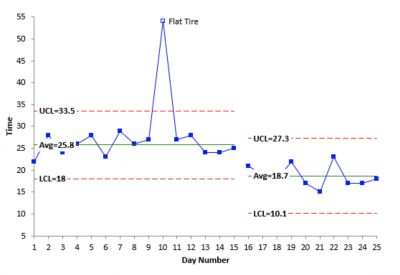
Common cause variation is present when the control chart of a process measure shows a random pattern of variation with all points within the control limits. Lessons learned from this case include the following. When a process is operating normally the curve above is the anticipated distribution of any critical process parameter t.
Control Charts to identify special causes. In a bank different transactions and customers require different amounts of time. A control chart can show two different types of variation special cause variation points out of limits or a non-random pattern of variation and common cause variation.
One of the tools that can be used to help identify areas of variation is the fishbone diagram. Control Chart is considered as one of the Seven Basic Quality Tools used for product and process improvement. A control chart and helps you distinguish between special and common causes of variation.
These root causes are then solved. This is the whole premise behind Six Sigmaidentification and reduction of variation. For example the thickness of a piece of rolled out steel plate will have variation that is due to the material and process that delivers.
Special Cause Variation is a process anomaly that is induced by an unpredictable event. In a DMAIC project we identify all such common cause variation. Common cause variation shows the process potential when the special causes of variance is eliminated from the system.
The assembly of automobiles planes and other product show to variation. If the measurements of a process are normally distributed then there is a 9973 chance that the measurement will be within plus and minus three standard deviations. Cause and Effect Fishbone Diagram Pareto Chart.
We find the reasons behind such variation in the process and drill down to the root causes. Common causes of variation are inherent to a system. Baking a loaf of bread.
These are consecutive data points that dont cross the median marked earlier. They show common cause variation. On a control chart common cause variation indicates a random distribution around the control limit.
Use run charts to look for common cause variation. The ovens thermostat allows the temperature to drift up and down slightly. Edwards DemingBriefly common causes also called natural patterns are the usual historical quantifiable variation in a system while special causes are unusual not previously observed non-quantifiable variation.
Determine Special Cause Process Variation. The part characteristics show variation. Common cause variation and special cause variation.
Shift - seven or more successive data points falling on. Meanwhile use control charts to look for special cause variation. Continuous improvement of all things all the time at all levels forever is _____.
The best tool to determine if the variation is Common Cause or Special Cause is the Measure Phase Control Chart. A Measure Phase Control Chart often is referred to as time series plot used to monitor a process over time. Common cause of variation Special cause of variation.
This can also be a result of the environmental factors or the method used. Common cause variation is a measure of the processs potential or how well the process can perform when special cause variation is removed. SPC technique uses Control Charts to monitor and control the Special Cause of variations present in the manufacturing process.
Points on the control chart are labelled with the reason for the special-cause variation. Identify root causes of problems. Common cause of variances are quantifiable expected natural usual historical and random causes of variances in a process.
Mark your median measurement. Common cause variability is a source of variation caused by unknown factors that result in a steady but random distribution of output around the average of the data. Services are subject to variation.
To accomplish this it is important to distinguish between two types of variation. This is the basis of control charts. If you wanted to see the data variation over time which tool would you use.
Statistical Process Control is a scientific visual method used to monitor control and improve processes by eliminating special cause variation from manufacturing service and financial processes. To offset the problem with run charts not accounting for special cause and common cause variation the problem can be rectified by using _____. The most important use of the 5-Why routine is to.
In the Labeldrop-down list select Cause. The image above depicts a Gaussian distribution which depicts a natural distribution of points about a mean. Describe the CTQCs more accurately.
Chart the measurements from your process over time. The most common points on the diagram are contributions to the issue by material method manpower measure environment and machine. When a control chart shows common cause.
Management culture must change from _____ to _____ and allow for the. 2 Pareto charts are useful for focusing on the areas of. Common and special causes are the two distinct origins of variation in a process as defined in the statistical thinking and methods of Walter A.

8d Problem Solving Technique Problem Solving Solving Discipline

Special Cause Variation Definition

What Is Variation The Law Of Variation Asq

Special Cause Variation Definition

Variation Common Cause Definition

Special Cause Vs Common Cause Variation Quality Gurus

Control Chart Types Of The Control Chart In 7 Qc Tools Chart Study Process Run Chart

Using Control Charts To Detect Common Cause Variation And Special Cause Variation Minitab

5s Meaning 5s System Implementation Steps With Benefits Meant To Be System Improve
Control Chart Rules Are Helping Us To Identify The Special Cause Of Variation From The Process And By Elimina Chart Process Control Statistical Process Control

Variation Special Cause Definition

When It Comes To Prioritization Of Many Causes For An Effect Pareto Chart Is A Powerful Tool Pareto Principle States Th Chart Lean Six Sigma Pareto Principle

Six Sigma Road Map Lean Six Sigma Business Process Management Six Sigma Tools

5 Lean Six Sigma Tools That Apply To All Processes Six Sigma Tools Lean Six Sigma Project Management Professional

Using Control Charts To Detect Common Cause Variation And Special Cause Variation Minitab
7 Qc Tools Definition

Special Cause Variation Definition

Variation Common Cause Definition

Special Cause Vs Common Cause Variation Quality Gurus


Comments
Post a Comment